Best Prediction Market Platforms
Prediction markets let you trade on what’s going to happen next, whether that’s who wins a presidential election or who walks away with the Oscar for Best Actor. In these markets, you buy “Yes” or “No” shares if you think something will or won’t happen. Get it right, and each share pays out a fixed amount, typically 1 USD. Get it wrong, and those shares are worth nothing.
Most of the users and money flow through just two platforms: Kalshi and Polymarket. Here, we will cover the major platforms, the types of contracts you can trade, how pricing functions, the legal side, risks you should be aware of, and what taxes look like.
Current Platforms Overview
Dozens of prediction market platforms exist, but only the most liquid ones carry real weight. Traders gravitate toward platforms where they can move in and out of contracts without pushing the price around, so volume naturally pools on just a few exchanges.
Prediction Market Platform Comparison Table
| Platform | Type | Regulation | US Access | International Access | Funding | Main Categories | Liquidity Level |
|---|---|---|---|---|---|---|---|
| Kalshi | Regulated exchange | Regulated by the CFTC (USA) | Yes | Yes (with geographic restrictions) | Fiat money | Politics, Economics, Events | Very high |
| Polymarket | Crypto exchange | International entity. Also regulated by the CFTC (USA) | Yes | Yes (with geographic restrictions) | USDC (Crypto) | Politics, Sports, Crypto, Global | Very high |
| PredictIt | Political market | CFTC no-action framework | Yes (with limits) | Limited | Fiat-style | Politics | Medium |
| ForecastEx | Regulated exchange | Regulated by the CFTC (USA) | Yes | Limited | Fiat money | Economics and event contracts | Medium |
| Manifold | Forecasting community | Unregulated exchange | Yes | Yes | Internal tokens | General user markets | Low |
| Metaculus | Forecasting platform | Not a trading exchange | Yes | Yes | Reputation-based | Science, technology, geopolitics | Not based on liquidity |
What Are Prediction Markets?
Simple Definition
Think of a prediction market as a marketplace for contracts tied to future events. Instead of buying shares of a company, you’re buying shares in the answer to a question, something like “Will the Fed raise interest rates at its next meeting?” or “Will the Dodgers win the World Series?”
The price of a contract tells you what the crowd collectively thinks the probability of that outcome is. A “Yes” share trading at $0.60 means traders believe there’s roughly a 60% chance it happens. If the event occurs, the contract pays out $1.00. If it doesn’t, the value drops to $0.00.
Let’s say there’s a market on whether it’ll rain in your city tomorrow. You grab a “Yes” contract for $0.30. Rain comes, and you collect $1.00 per share for a $0.70 profit. Sun stays out, and your contract is worthless, costing you the $0.30 you put in.
You’re also free to sell your position to another trader at any point before the event resolves if your thinking changes.
Event Contracts: YES/NO Structure
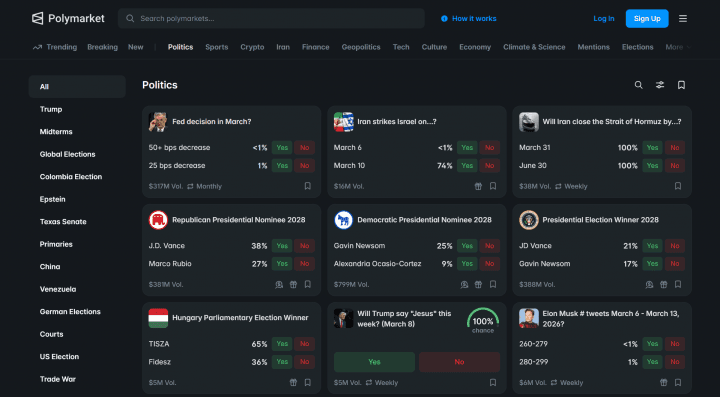
The vast majority of prediction market contracts follow a simple binary setup, consisting of “Yes” or “No” options. The odds for both sides always add up to 100%, represented as $1.00.
Take a contract that asks, for example, “Will the Federal Reserve lower interest rates this month?” You have two choices.
- “Yes” means you believe they’ll cut rates before the month’s end.
- “No” means you believe they won’t.
If the Fed does cut rates, “Yes” shareholders collect $1.00 per share, and “No” shareholders lose what they invested.
Some markets offer multiple outcomes. A question like “Who will win the soccer World Cup?” might list several teams, each with its own price. But for the most part, you’ll be dealing with straightforward “Yes”/”No” contracts.
How Prices Represent Probability
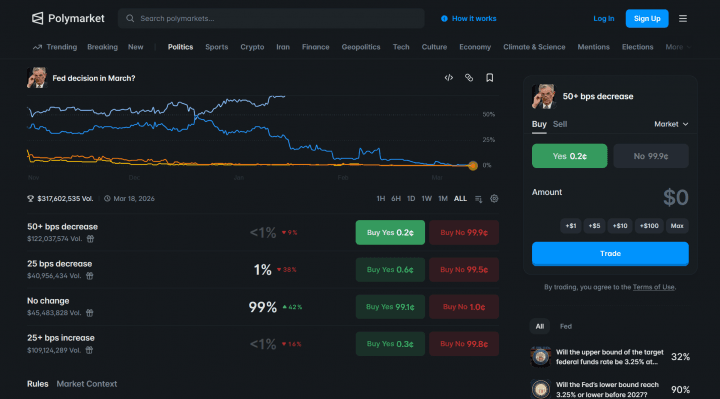
Contract pricing on these platforms is a direct window into how the market views the likelihood of an event. Since a correct outcome always pays $1.00, you can read the price in cents as a percentage.
A “Yes” contract at $0.60 tells you the market sees a 60% chance it happens. The “No” contract would sit at $0.40, reflecting the remaining 40%. $0.00 means the outcome is considered impossible, $1.00 means it’s a done deal, and everything between is where buyers and sellers have found their equilibrium on the risk.
As new information surfaces, prices adjust. Say you bought a share at $0.60, and fresh data shifts the market’s view to an 80% probability. Your share is now worth $0.80, and you could sell right then for a $0.20 profit without waiting for the final outcome.
Why Prices Move
Prices are in constant motion, driven by a few factors:
- New Information: Fresh data, polls, leaks, or official statements can rapidly reshape how participants view the odds, triggering a wave of orders to reflect the new consensus.
- Market Liquidity and Depth: In low-volume markets, one big order can shove prices around. Deeper markets require a lot more capital to produce the same kind of move.
- Order Flow and Positioning: A surge of institutional traders, hedging bots, or other large players can throw off the balance. Forced liquidations for risk management purposes can also accelerate existing price moves.
Prediction Markets vs. Sportsbooks
They might look similar on the surface, but prediction markets and sportsbooks work very differently under the hood.
| Feature | Prediction Markets | Sportsbooks |
|---|---|---|
| Whom do you bet against? | You trade directly with other users who hold an opposing view. | You play against the house, which sets the odds and takes the risk. |
| Prices | Prices fluctuate based on supply and demand, reaching a market equilibrium. | Odds are set by the operator and include a built-in profit margin. |
| Closing a position | You can sell your contract to another user at any time before the event concludes. | Your bet is typically locked in until the end. A cash-out option is sometimes available, but at reduced odds. |
| Limits | Your potential profit is determined by the liquidity available on the platform. | The platform sets a maximum amount of money you can wager per event. |
Prediction Markets vs. Polls
Prediction markets consistently outperform traditional polls for the simple reason that you have to put your money where your mouth is.
Polls ask people who they think will win or what outcome they’d prefer. Prediction markets force you to commit real cash to what you believe will actually happen. Without money on the line, poll responses get colored by biases and wishful thinking. You can say whatever you want with zero financial consequences.
In a prediction market, the question shifts from “what do you hope happens?” to “what do you expect to happen?” When your own cash is at risk, you’ve got every reason to do your homework and leave personal preferences at the door.
There’s also a speed advantage. Prediction markets react to new information in real time, while a poll is just a frozen snapshot from the moment it was taken.
So the next time you want a live read on how an event is shaping up, checking a prediction market platform could give you a clearer picture than any poll.
How Prediction Markets Work- Step-by-Step
A prediction market moves through three distinct phases, from the initial question all the way to the final payout:
- Market creation: The platform posts a question about a future event with a clear deadline (for example, “Will Real Madrid win the Champions League this year?”). Early trades establish the initial perceived probability for the “Yes” and “No” outcomes.
- Market movement: Now the market is live and open for business. If Real Madrid wins its first match convincingly, traders pile into “Yes” shares, pushing the price higher. If their star player goes down with an injury, “No” shares gain value while “Yes” shares slide. You can trade your shares with other participants or hold them until the event is over.
- Market resolution: Once the deadline passes, the platform checks a designated official source (like the UEFA website) to confirm the result. Say Real Madrid wins. Traders holding “Yes” contracts collect $1.00 per share, while “No” holders get nothing.
Contract Structure and Payout Model
Prediction market contracts operate on a fixed-payout system. The most you can win per share is always a set amount, whether that’s $1.00, €1.00, or 1 stablecoin like USDC, depending on the platform.
Every contract spells out the question, the options (usually “Yes” and “No”), settlement rules, the expiration date, and the official data source used to determine the result.
When you buy a contract, you pay the current market price, and that amount is the most you can lose. Pick up a share for $0.60, and $0.60 is your maximum downside.
Once the event date arrives and the result is official, the payout happens automatically. The system checks the outcome against the designated source; the losing option drops to $0.00, and the winning option pays $1.00. Your net profit is just the dollar payout minus what you originally paid.
Order Book: Bid, Ask, and Spread
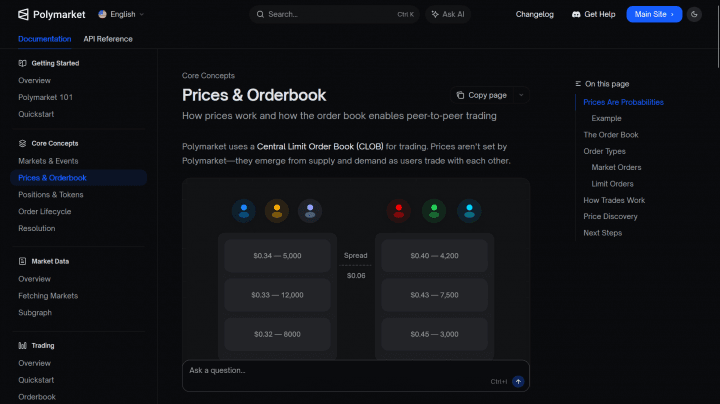
Unlike sportsbooks, where an operator sets the odds, prediction markets run on an order book. This is a public list showing what participants are willing to pay for a contract (bid price) and the price they’ll accept to sell one (ask price).
Since you aren’t trading against the platform itself, a trade only happens when someone else takes the opposite side. The moment a buyer’s bid matches a seller’s ask, the platform executes the trade, and that price becomes the new market quote.
When trading event contracts, keep in mind these terms:
- Bid: The highest price a buyer is willing to pay for a contract.
- Ask: The lowest price a seller is willing to accept for their contract.
- Spread: The gap between the highest bid and the lowest ask. A tight spread signals plenty of liquidity.
Market Orders vs. Limit Orders
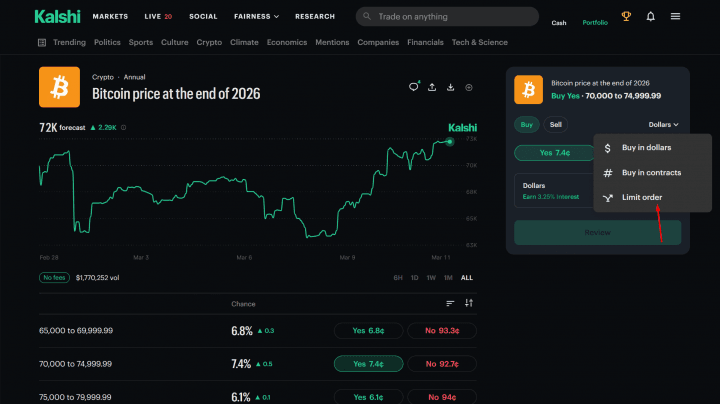
You’ve got two main ways to buy a contract on a prediction platform: market orders and limit orders.
A market order buys at the best available price right now, so the platform fills it instantly at the lowest ask in the book. This is the fastest way to get into a position, but in low-liquidity markets, your order might eat through multiple price levels and fill at a worse price than you anticipated.
A limit order lets you set the exact price you’re willing to pay. Your bid and quantity get placed in the order book, and the trade only executes if another trader agrees to sell at your price or better. You’re guaranteed not to overpay, but the flip side is your order might sit there unfilled if the market never reaches your limit.
Liquidity and Slippage
Liquidity in prediction markets is the total amount of money sitting in the order book, ready to be traded against.
On high-liquidity platforms, you can drop a large order and get it filled at a single price because there are enough participants on the other side. In low-liquidity markets, that same order might eat through all the contracts at the best price, with the remainder filling at progressively worse levels. That negative price movement while your order is executing is called slippage.
Here’s what that looks like in practice. Say you place a market order for 100 “Yes” contracts quoted at $0.60 each, expecting to pay $60.00. But the order book is thin.
- Only 20 contracts are available at $0.60 ($12.00).
- The next 30 contracts are priced at $0.65 ($19.50).
- The last 50 you need are priced at $0.70 ($35.00).
The platform fills your order across all three levels in an instant. Instead of $60.00, your total cost comes out to $66.50.
Fees and Total Trading Cost
Before you start placing trades, it’s worth understanding the costs involved:
- Platform Commissions: Polymarket.com charges minimal fees on some transactions, but you’ll also want to factor in blockchain network fees. Kalshi and Polymarket US post clear fee schedules on their websites.
- Spread: This is the hidden cost of entering and exiting a position with a market order. In illiquid contracts, a wide bid-ask gap means the price has to move significantly in your favor just for you to break even.
- Opportunity Cost: This is the money tied up in a position until it resolves. While your funds are locked in a contract, you can’t deploy them elsewhere or earn interest.
Settlement Process
Settlement kicks off once the event in your contract is over. The platform freezes trading and waits for the official outcome from the designated source, whether that’s a government announcement, a sports federation, a company report, or another verified data provider.
Once the result is confirmed, the market applies it to all contracts. The winning side gets $1.00 per share, and the losing side goes to $0.00. Payouts for winning contracts are automatically credited to your account, the market closes, and all funds are released.
Dispute Resolution and Market Cancellation
Occasionally, an event’s outcome can be murky. Maybe the contract rules didn’t account for every scenario, or the official source issues a correction. When that happens, the platform pauses the market to sort things out.
Centralized markets like Kalshi and Polymarket US have a legal and regulatory framework in place for handling disputes.
On crypto-native platforms like Polymarket.com, the blockchain provides its own dispute resolution mechanism. Holders of governance tokens, a special type of crypto that carries voting rights, can vote on the correct outcome.
If a contract turns out to be flawed or the outcome simply can’t be verified, the platform may cancel it entirely. In that case, all trades get reversed and everyone receives their original money back.
Market Categories
Prediction markets stretch well beyond finance. You can find contracts on everything from inflation data to weather patterns.
Trending / Breaking Markets
These markets spring from breaking news and often resolve in hours or even minutes. For instance, if a recording of a tech CEO saying something controversial leaks, a market might pop up asking, “Will the CEO resign in the next 24 hours?”
Trending markets are known for sharp volatility and heavy trading volume. They’re also among the riskiest, since there’s usually not much reliable information available to base a decision on.
Politics
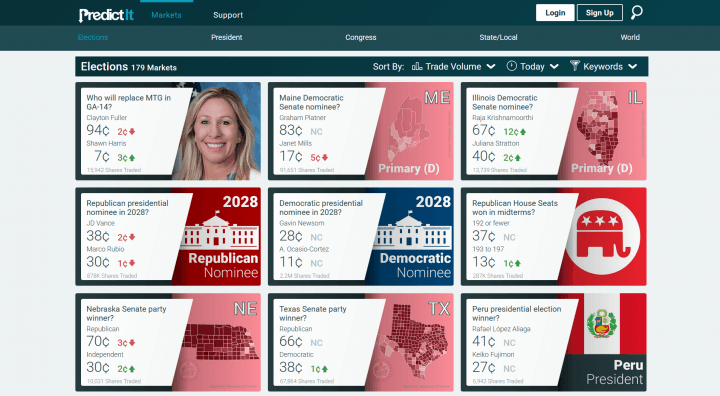
Political contracts rank among the most popular offerings. As campaigns unfold, these markets frequently produce forecasts that are more responsive to real-world developments than traditional polls:
- Elections: Trade on who wins, how many seats a party captures, vote shares, or even the date the final result gets confirmed.
- Legislation: Contracts around new regulations, bills, court interpretations, political appointments, or judicial approvals.
- Policy Outcomes: Trade on tariff rates, tax changes, immigration numbers, subsidies, and climate targets.
- Geopolitical Events: Speculate on government alliance decisions, international agreements, military actions, and foreign policy shifts.
Sports and Esports
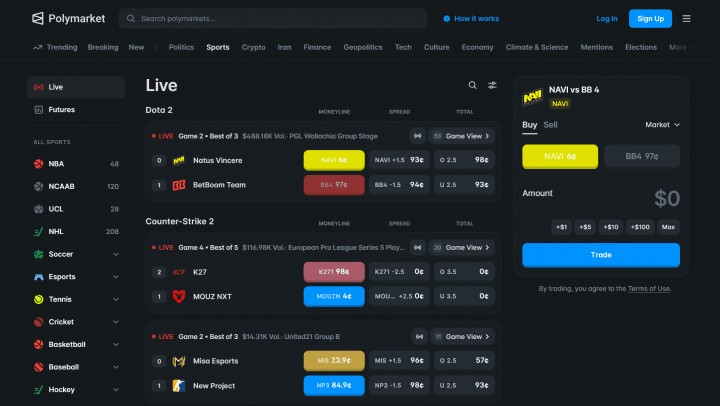
Right alongside politics, sports are a massive part of prediction markets. Here you can find events like:
- Match Outcomes: Predict a match winner, a draw, the score difference, or specifics like red cards.
- Tournament Winners: Pick the team or player you think takes the whole competition.
- Accumulated Results: Make longer-term forecasts on player or team stats, such as a player’s season scoring average or a team’s total goals against.
Crypto
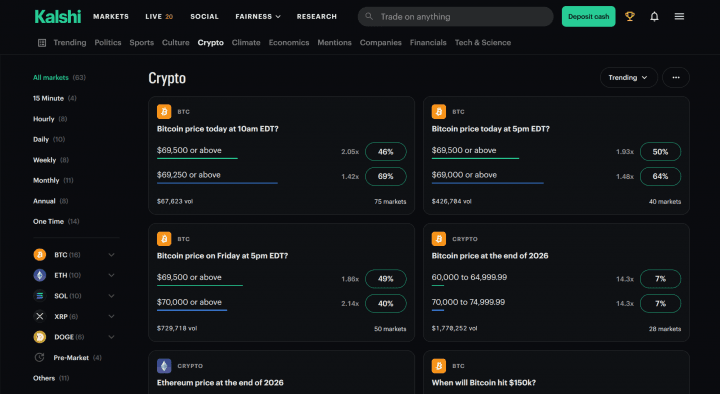
Crypto prediction markets let you put your blockchain knowledge to the test on events like:
- Price Targets: Bet on whether a cryptocurrency like Bitcoin will reach a certain price by a specific date.
- Regulatory Decisions: Trade on the outcomes of legal cases against crypto companies, ETF approvals, or lawsuits from agencies like the CFTC.
- Major Industry Events: Speculate on protocol upgrades, network forks, airdrops, token launches, or network outages.
Finance and Economy
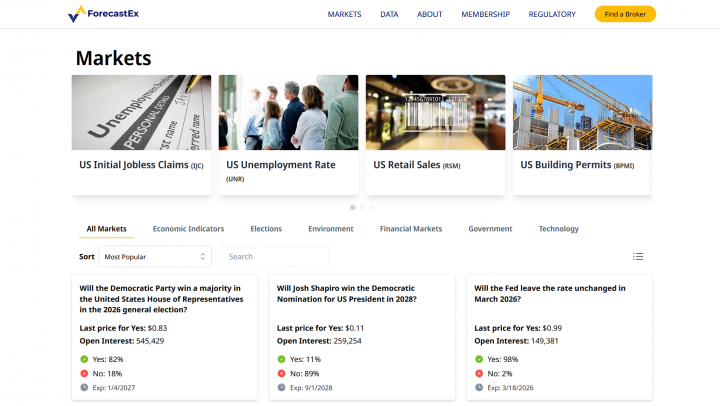
This category has done a lot to pull prediction markets into the mainstream, and it includes:
- Interest Rates: Trade on decisions by central banks like the Federal Reserve or the European Central Bank.
- Inflation Reports: Predict whether the CPI or other inflation figures will rise, fall, or hold steady.
- Employment Data: Forecast official numbers for unemployment claims or changes in non-farm payrolls.
- Economic Milestones: Bet on events like the declaration of a technical recession, changes in a country’s credit rating, or stock market index performance.
Geopolitics and World Events
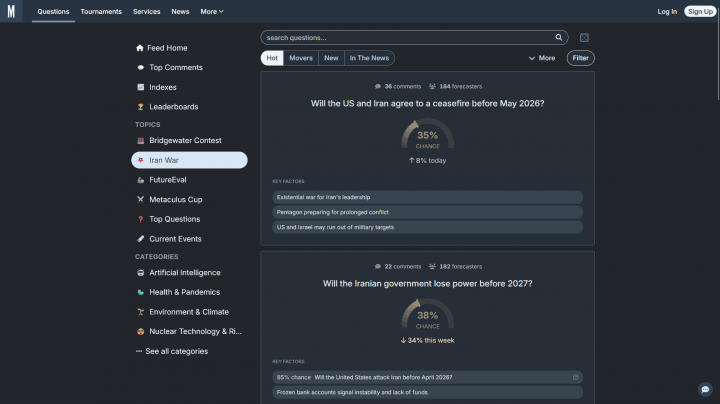
These contracts cover the outcomes of wars (both military and trade), international treaties, humanitarian events, and strategic alliances.
It’s worth noting that some platforms restrict these markets. To comply with regulations in certain countries regarding terrorism or violence, some operators don’t allow speculation on contracts that could affect social stability.
Technology and Companies
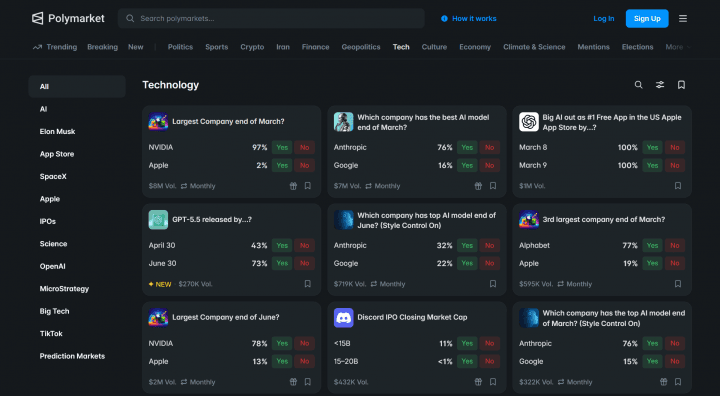
You’ll find contracts on product launches, company mergers, quarterly earnings, and bankruptcy filings. Maybe there’s a market on when the next iPhone drops or whether a private space mission succeeds. If you’ve got a knack for reading financial statements, you can trade on earnings reports or dividend decisions.
Culture and Entertainment
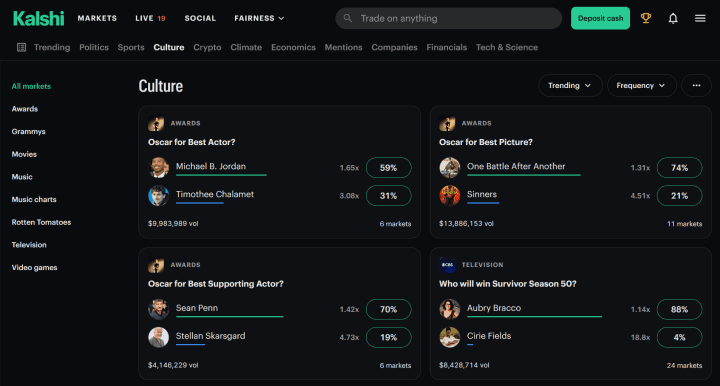
This area covers industry awards, box office numbers, social media influencers, YouTubers, and pop culture moments (like when a certain celebrity might get married). You could try calling which film wins a major award or whether an influencer boxing match actually happens.
Climate and Science
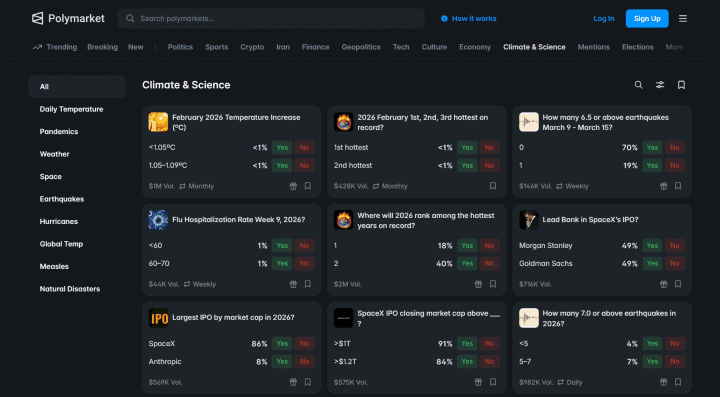
Here, you can trade contracts predicting whether temperature records will fall, if carbon emission levels will hit a target, if a hurricane will reach a certain area, or when major weather events will occur. Markets on space mission launch dates, physics breakthroughs, and AI advances also show up in this category.
The Prediction Market Industry in 2026
After a burst of growth in recent years, the industry is settling into a more mature phase. Platforms are getting regulated, and institutional money is flowing in. Get a handle on these shifts and think about where to place your trades going forward.
Why the Market Is Concentrated
Polymarket and Kalshi dominate the space because they are the most liquid, and liquidity is everything in prediction markets. Traders want to be where big orders won’t cause wild price swings, so everyone gravitates toward the same platforms.
Unlike a typical industry where many similar companies can coexist, prediction markets carry a strong first-mover advantage. Whoever builds the most liquidity first creates a self-reinforcing loop: More users bring more money, more money means fewer execution problems, and fewer execution problems attract even more users.
A new platform trying to compete would need to crack the liquidity problem from day one. Launching with no volume means prices carry wide spreads, which scares off traders. Without a critical mass of users, a new entrant can’t survive.
Barriers to Entry (Regulation, Capital, Compliance)
New prediction markets face some steep obstacles in trying to challenge the established players:
- High Capital Requirements: Launching a prediction market is expensive from the start. Beyond putting up their own funds to seed initial liquidity, platforms need bank-grade technology. If the order book goes down for even a second, users lose confidence and leave.
- Licensing and Regulatory Compliance: Getting the proper permits is a long and costly process. In many countries, these markets sit in a gray zone between gambling and complex financial products. Winning approval from a regulator can take years of audits.
- Anti-Money Laundering and Security: Every region has its own Know Your Customer (KYC) and Anti-Money Laundering (AML) rules. Platforms that don’t verify their users face multimillion-dollar fines and risk losing their licenses.
Network Effects and Liquidity Concentration
The network effect is when a platform becomes more valuable as more people use it. This concentration of users draws in liquidity, which pulls in even more users.
When a contract has deep liquidity, you can trade with a narrow spread, which lowers your costs. That price efficiency attracts market makers and other large traders. The more participants that join, the bigger the incentive to create new markets, and the deeper the order book gets.
Growth Trends and Institutional Interest
The prediction market space is growing up, and new trends are taking shape. Over the last few years, the industry has gone from a niche for retail traders to an ecosystem attracting institutional finance and large-scale risk management, thanks to these factors:
- The Arrival of Smart Money: Proprietary trading firms and quantitative funds have entered the space. As liquidity improves, they deploy algorithmic bots that spot and correct price differences in milliseconds, tightening spreads and making markets more efficient.
- Hedging: Large corporations and banks have started using these markets to hedge against real-world risks. Instead of relying on expensive traditional derivatives, they buy binary contracts as a form of direct insurance.
- Data as a Product: Information providers like Bloomberg now display probabilities from these platforms right alongside traditional Wall Street numbers. A contract’s price has become another recognized way to gauge market consensus.
The Platforms Explained
Kalshi and Polymarket handle most of the prediction market volume, but they aren’t the only game in town. Here’s a closer look at the most important platforms.
Kalshi
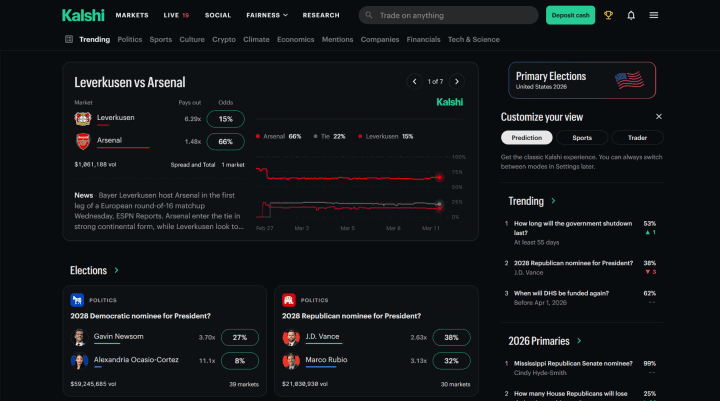
Kalshi is a regulated exchange for trading event contracts. You buy and sell forecasts on future events directly with other users, using “Yes” or “No” shares whose prices reflect the community’s assigned probability. A correct prediction pays $1.00 per share.
Kalshi is fully regulated as a Designated Contract Market (DCM) under the U.S. Commodity Futures Trading Commission (CFTC). The company operates under federal oversight and uses a registered clearinghouse to protect user funds and transactions.
Though regulated in the U.S., the platform accepts clients from many other countries, so just check its list of excluded nations before signing up.
Categories offered:
- Politics
- Sports and Culture
- Cryptocurrencies
- Climate and weather phenomena
- Economics
- Technology and Finance
Kalshi’s biggest strength is its CFTC regulation, which removes legal risk for U.S.-based users. The company also offers deep liquidity in certain markets, and clear settlement rules tied to government data sources. The trade-offs include a strict KYC process, a long list of blocked countries, and scheduled maintenance windows when trading isn’t available.
Kalshi works well for traders who want to speculate on macroeconomic events within a regulated framework. It’s also a good fit for quantitative funds using its API and businesses looking to hedge risks.
Polymarket
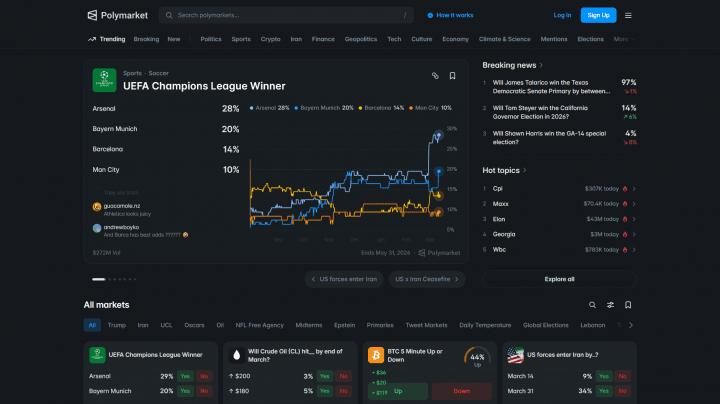
Polymarket is a decentralized exchange where you can trade on the outcome of nearly any future event using cryptocurrency. Prices are denominated in USDC (a stablecoin pegged to the U.S. dollar), and each winning share pays $1.00. Built on a blockchain, it runs 24/7 without intermediaries.
The platform’s infrastructure sits on the Polygon blockchain, which keeps transactions cheap and fast. You don’t deposit money into a company account. Instead, you keep full control of your USDC in your own digital wallet. Final settlement is handled by smart contracts and the UMA Optimistic Oracle system.
For U.S. customers, Polymarket operates under a separate legal structure approved as a DCM by the CFTC. If you’re based in the U.S., Polymarket US gives you the same legal protections as Kalshi.
Categories offered:
- Trending markets
- Politics
- Finance
- Crypto
- Sports
- Technology
- Geopolitics
- Pop culture
Polymarket stands out for its high liquidity, rapid listing of new markets, and non-custodial design, meaning you stay in control of your funds at all times. Most contracts carry no fees, and withdrawals are instant.
On the flip side, you need to be comfortable with cryptocurrencies and digital wallets. In ambiguous markets, resolutions made by decentralized oracles can sometimes spark disputes.
This platform is built for users who are at home in the Web3 world. It’s designed for probability-focused traders, analysts, journalists, and quantitative traders who want a flexible tool across a wide range of topics without the red tape of traditional regulated platforms.
PredictIt
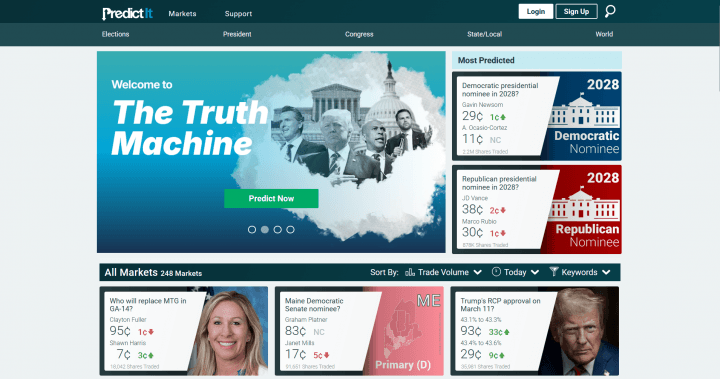
PredictIt is the original platform for forecasting U.S. political outcomes, focusing exclusively on contracts tied to government events, elections, appointments, and legislation. That narrow focus has drawn a specific audience of researchers, pollsters, analysts, and political junkies.
The platform isn’t registered as an exchange but operates under a “no-action letter” from the CFTC, allowing it to run as a small-scale, primarily educational project. A July 2025 regulatory update raised user contribution limits and allowed for non-governmental management, but the platform still can’t offer cryptocurrency trading or work with institutional traders.
ForecastEx
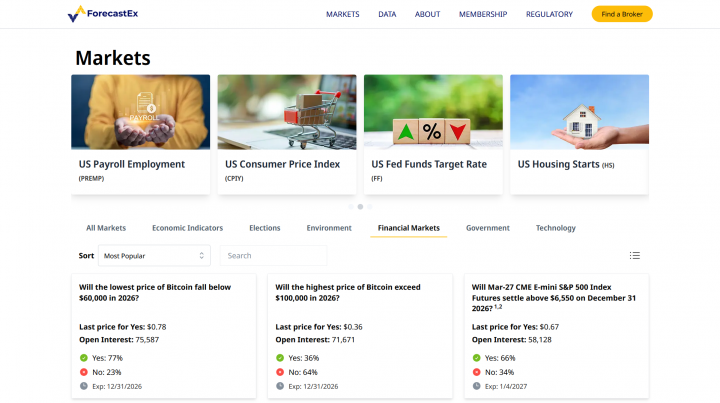
ForecastEx is a market backed by Interactive Brokers that offers contracts on financial events. What sets it apart is that it pays interest on your positions (something you don’t typically see) and requires you to “offset” a position to exit, meaning you have to buy the opposing contract.
ForecastEx is fully regulated in the U.S. and was registered in 2024 as a CFTC-designated contract market and clearinghouse. The commission classifies its model as being based on fully collateralized binary options.
This exchange focuses on economic indicators like inflation, GDP levels, the trade balance, and unemployment numbers, which draws institutional investors and specialized financial traders. You won’t find markets on crypto or celebrities here.
Manifold
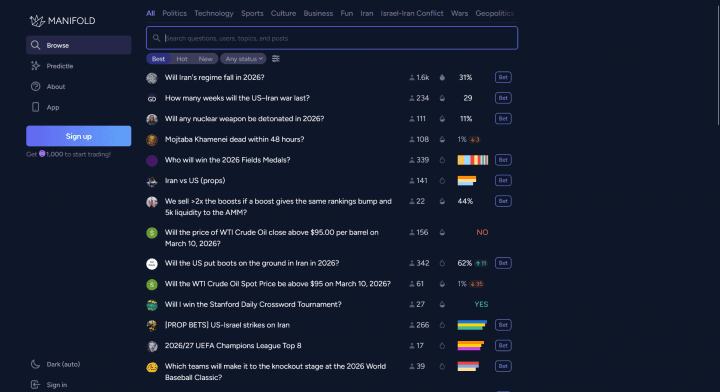
Manifold is a blockchain platform where users trade with a special token called Mana instead of real money. What makes it unique is that users can create contracts on virtually anything, from “Will I exercise this week?” to “Is my girlfriend going to leave me tonight?”
The system uses an automated market maker to operate 24/7 and set prices that reflect the probability of each outcome. When you sign up, you get a free batch of Mana, which you can grow by making accurate predictions.
Metaculus
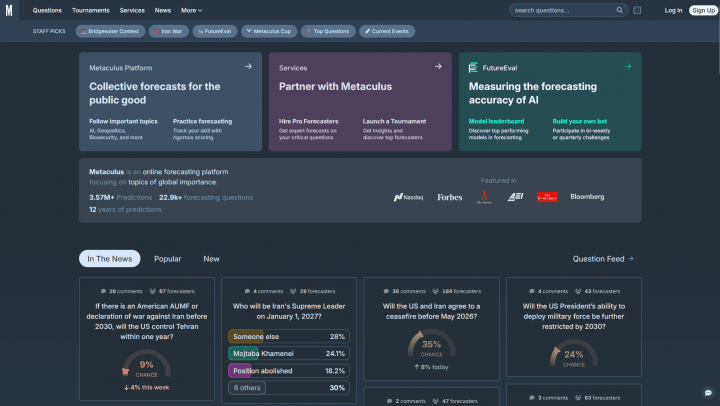
Metaculus is a platform focused on probability forecasts for scientific and geopolitical events. It doesn’t use real money, so there’s no financial risk involved. Users simply log in and submit their predictions.
The platform runs a reputation algorithm that gives more weight to predictions from users with a strong accuracy track record, which helps guard against manipulation.
This approach mainly attracts researchers, scientists, data analysts, and science enthusiasts who want to measure the potential effects of new technologies and track global trends.
Kalshi vs. Polymarket
Kalshi and Polymarket are the two heavyweights in the prediction market space, but they have some meaningful differences worth knowing before you pick one.
Who Can Use Each Platform
Kalshi is no longer limited to the U.S., and Polymarket is back in the U.S. market. Both, however, carry specific geographic restrictions and KYC requirements.
| Platform | Kalshi | Polymarket |
|---|---|---|
| Permitted Countries | United States, Germany, Spain, Portugal, Netherlands, Ireland, Sweden, Norway, Austria, Greece, and more. | United States, Spain, Portugal, Switzerland, Ireland, Sweden, Norway, Austria, Greece, Canada, Mexico, and more. |
| Excluded Countries | France, United Kingdom, Italy, Belgium, Switzerland, Poland, Russia, Canada, Australia, China, and more. | United Kingdom, France, Germany, Italy, Netherlands, Belgium, Russia, Poland, Australia, and more. |
| KYC | Mandatory and rigorous. Requires documents and tax identification to comply with federal laws. | No KYC process required, unless you are a United States customer. |
The list of allowed countries can change, so it’s always smart to check directly with the platform before signing up. Don’t try using a VPN to get around restrictions because that’s against the rules on both exchanges.
Regulatory Differences
From an investor’s perspective, Kalshi functions like a registered brokerage. The company meets all the standards of a CFTC-supervised exchange, and its clearinghouse protects against liquidity issues while acting as a third party in disputes. Any problems are handled under federal law.
Polymarket.com runs on a hybrid model, settling on-chain using cryptographic oracles. Your funds stay decentralized and under your control, and disputes go through the community, guided by decentralized incentives.
For users in the United States, though, Polymarket US offers a legal setup that mirrors Kalshi’s. In the U.S., the platform is regulated by the CFTC, giving users the same legal protections.
Liquidity and Volume Comparison
Kalshi and Polymarket are neck and neck for the top spot. As of early March 2026, on a weekly basis, Kalshi holds a slight edge with 53% of notional volume compared to Polymarket’s 47%.
The decentralized platform is closing the gap quickly, though. Polymarket already has more direct user activity than its main competitor, with 24.6 million weekly transactions versus Kalshi’s 18.7 million.
Market Variety and Listing Speed
Kalshi focuses on formal contracts with official settlement sources, which works well for weather or traditional financial markets that can be confirmed by recognized organizations. On the other hand, Polymarket hosts thousands of contracts on internet trends, Middle Eastern conflicts, AI developments, and unconventional research topics.
Both platforms cover major elections and sporting events. However, Polymarket ventures into areas where official public data might not exist, while Kalshi is stronger in local U.S. markets that may not appeal to a decentralized audience.
When it comes to breaking news, Polymarket’s architecture lets it list new markets in minutes. Kalshi’s regulated process involves mandatory reviews, which takes longer. The result is that Polymarket leads on emerging events, while Kalshi offers more stability.
Fees and Cost Structure
Though they offer similar products, fees at Kalshi and Polymarket are very different.
| Platform | Kalshi | Polymarket.com | Polymarket US |
|---|---|---|---|
| Buy or sell instantly (Taker Fee) | A maximum of approximately $1.75 per 100 contracts (half for indices like the S&P 500). | Free on most markets. | 0.10% of the total traded |
| Leave a pending order (Maker Fee) | A maximum of approximately $0.44 per 100 contracts left in the order book. | Free. | Free. |
| Settlement | Free. | Free. | Free. |
| Depositing with a Card | Up to a 2% fee on the deposited amount. | Intermediaries often charge 3% to 5%. | Not applicable. |
Deposits and Withdrawals
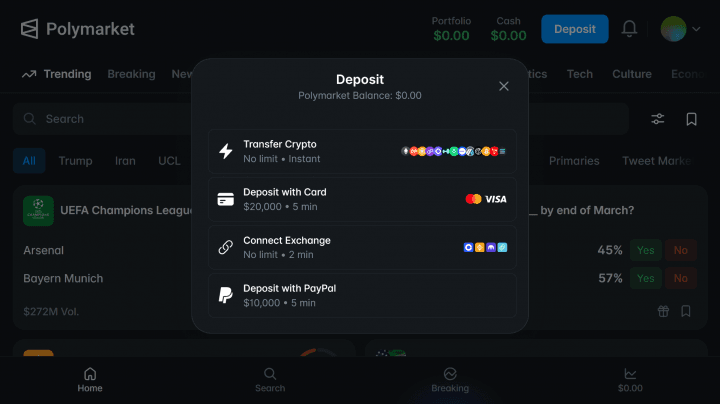
Kalshi lets you deposit via ACH, wire transfer, debit card, and even cryptocurrencies like USDC and USDT through a partner processor (which comes with fees since it’s not a direct blockchain transaction).
For withdrawals, the platform doesn’t charge for bank transfers, though fees might apply for debit card or crypto withdrawals depending on the third party.
Polymarket.com is built on the Polygon blockchain and uses USDC.e for its contracts. You can deposit by sending USDC from an exchange like Coinbase or by purchasing it directly with a credit card through MoonPay.
Polymarket.com doesn’t charge withdrawal fees, and funds go straight to your connected wallet. You may have to cover network fees when converting to another currency.
On Polymarket US, you aren’t required to use cryptocurrencies and can rely on traditional payment methods like bank transfers and credit cards, making the experience similar to Kalshi.
Which Platform Is Better for Different User Types
If you’d rather trade in a regulated environment, don’t mind going through KYC, and want to avoid dealing with cryptocurrencies, Kalshi is the better fit.
If you’re comfortable using a crypto wallet, managing private keys, and want more control over your funds, Polymarket is your platform. This exchange offers around-the-clock access and the deepest liquidity in the Web3 space.
Liquidity, Volume, and Market Quality
Liquidity, volume, and market quality are essential for executing trades smoothly. Without understanding them, you could end up moving the market price against yourself when working with larger positions.
What Liquidity Means
In prediction markets, liquidity is the amount of money available in the order book. This determines how easily you can enter or exit a contract without disturbing the price.
Unlike in sports betting, you need someone to take the other side of your prediction. If a market has two million dollars in liquidity and you want to place a $10,000 trade, there is more than enough money to absorb your order. However, if you try to trade three million, you’d eat through all the available liquidity, causing significant price slippage.
Without liquidity, there’s nobody on the other side, and spreads can get so wide that your expected return shrinks just from opening the position.
Volume vs. Open Interest
People often mix these up, but they measure different things:
- Volume: The total value of contracts traded over a given period, which helps you gauge the strength of a price trend. A volume spike often signals that new information has entered the market.
- Open Interest: The total amount of money currently locked in the market, invested and waiting for the event to resolve. This is a core indicator of a market’s overall liquidity.
Using both data points together, you can size up a market and decide if it’s worth your time.
| Market Condition | What it means | Example | Is it worth entering? |
|---|---|---|---|
| High OI + High Volume | A lot of institutional money is in, while daily news keeps trading active. | Short-term elections or this month’s Fed interest rate decision. | Yes, this is the sweet spot. |
| High OI + Low Volume | The smart money has already made its moves and is waiting. With no new info, there’s not much active trading. | Long-term presidential elections or climate contracts. | Safe, but slow-moving. |
| Low OI + High Volume | Everyone is speculating on a short-term news event, but no one is confident enough to leave their money in overnight. | Viral markets created hours ago based on a social media rumor. | High return / High risk. |
| Low OI + Low Volume | No one is interested in this event. There is no backing capital or daily trading activity. | A minor league sports game or a niche local political event. | Stay away. |
Spread and Execution Cost
A wide spread in an illiquid market is a hidden cost that catches a lot of new traders off guard. As mentioned above, the spread is the difference between the highest price a buyer will pay and the lowest price a seller will accept.
Let’s say you buy a contract where the bid is $0.65 and the closest seller is asking $0.68. Place a market order without thinking about the spread, and you’ve instantly lost $0.03 on the trade. The market price needs to climb to $0.69 just for you to squeeze out a $0.01 profit.
Risks of Thin Markets
Trading in illiquid, or “thin,” markets comes with real dangers. Unlike heavily traded events, these markets don’t have enough participants, which can create several problems:
- Extreme Volatility and Slippage: Even a small order can eat through all the available liquidity, artificially spiking the contract’s price.
- Spoofing and Distortion: Because it doesn’t take much money to move the price, bad actors can manipulate probabilities to create false impressions.
- Exit Trap: You might be sitting on a winning position on paper, but if there are no buyers, you could be stuck holding the contract until it resolves, unable to lock in your gains.
Legal and Regulatory Landscape
Two Legal Models
The prediction contract industry operates under two main regulatory models, which determine how a platform handles money and where it can do business:
- Regulated Exchanges: These are supervised by government agencies like the CFTC in the United States. They’re licensed to offer derivative instruments and must keep customer funds separate through clearinghouses that guarantee every fiat money transaction. Strict KYC checks are required.
- International Crypto Platforms: Operate outside the traditional financial system, using blockchain technology and stablecoins. They don’t need government licenses for users to trade with each other. However, their decentralized nature often places them in a legal gray area.
United States Framework
In the United States, the rules fall under the Commodity Futures Trading Commission. Because prediction markets involve profiting from the outcome of future events, lawmakers classify them as financial derivative contracts.
Unlike casinos or sports betting, these markets fall under laws like the Commodity Exchange Act, which means any exchange serving U.S. customers needs government approval. Once approved, they must maintain a transparent order book and cannot list contracts on certain events, like acts of terrorism.
Europe and Other Regions
The legal treatment of prediction markets varies widely by country. Each nation decides whether to classify these contracts as gambling, regulated financial derivatives, or something that’s banned outright.
In Europe, regulation is handled at the national level. Countries like France and Germany require prior approval and maintain lists of approved and banned operators. In the United Kingdom, the Gambling Commission reviews these markets and often classifies them as betting intermediaries. Platforms that don’t comply can face penalties.
In Canada, classification falls to provincial financial regulators. For example, in Ontario, securities authorities have treated short-term prediction contracts as financial binary options, banning their sale to retail investors. At the federal level, markets on sports outcomes also fall under the criminal code.
In Australia, the Australian Communications and Media Authority has direct technical control. If it finds a foreign site operating without a license under the country’s Interactive Gambling Act, it can order local internet service providers to block the website.
Why Availability Changes by Country
Many platforms use geo-blocking to stay on the right side of the law. Your physical location determines your access because lawmakers in different countries define these markets in different ways. On top of that, many platforms proactively block access to avoid fines from state regulators who penalize operators for serving their residents without a license.
Political and Sports Market Sensitivities
Regulators are particularly strict with predictions on elections and sports because of the potential for manipulation. Certain markets on these topics are often banned for these reasons:
- Integrity of the Democratic Process: Allowing large-scale betting on an election creates the risk that big players could try to sway public opinion.
- Match-fixing: The money involved creates incentives for bribing players or referees and for leaking private information.
- Insider Trading: In politics, aides with access to internal polling data that isn’t public could use that information to gain an unfair edge.
Risks of Prediction Markets

Prediction markets carry a unique set of risks that differ from conventional financial instruments:
Total Loss Risk
On binary “Yes” or “No” contracts, a wrong prediction means you lose 100% of the money you put into that position. Unless you sell to another trader before the outcome is decided, your investment goes to $0.00.
Liquidity Risk
This is the risk of not finding a buyer when you want to sell, either to lock in a profit or cut losses. In thin markets, bids can sometimes vanish entirely, forcing you to hold your position until settlement.
Regulatory Risk
A platform could be blocked or fined by the government. If an exchange doesn’t comply with a ban and has its assets frozen, you could lose access to your funds permanently.
Platform Risk
On regulated platforms like Kalshi and Polymarket US, there’s the risk of the company going bankrupt and freezing your funds. If a platform doesn’t properly oversee its contracts or has server problems, your orders might not execute correctly.
Information Risk
You’re often trading against large institutions that get information before it becomes public. These players can react instantly to new polls or reports, wiping out any edge you thought you had.
Volatility Risk
Unconfirmed rumors can send contract prices swinging wildly. These sharp moves, often driven by false speculation, can force traders to close positions at a heavy loss before the information can be verified.
Crypto Infrastructure Risk
For blockchain-based platforms like Polymarket.com, risks include smart contract bugs, wallet hacks, and stablecoins losing their peg. The networks these exchanges run on have no central authority to return your USDC or reverse fraudulent transactions.
Taxes and Reporting
Like any activity that generates income, trading on prediction markets is usually taxable. As an investor, it’s on you to understand the local rules regarding your gains and losses to avoid penalties.
Are Profits Taxable?
In most cases, profits from these markets are subject to either capital gains or income tax, depending on where you live. Most tax authorities treat this activity like trading on the stock market, though the exact classification varies. Some countries categorize it as financial income, while others treat it as gambling winnings, which can mean different tax rates.
Record Keeping
The good news is you don’t have to track every trade by hand. Platforms provide detailed reports to help:
- Regulated Platforms: They function like traditional brokers and give you year-end tax forms (like the 1099-B in the U.S.) listing your gains and losses.
- Decentralized Platforms: They store all your transactions permanently on the blockchain. You can export a CSV file from the platform or use crypto accounting software like CoinTracker to organize your records.
Reporting Considerations
When filing your taxes, don’t forget to deduct your losses. Just as gains are taxable, losses from wrong predictions can usually offset capital gains from your winning contracts. Keeping a clean record of your losing “No” contracts is key to lowering your net tax bill.
Practical Guide for New Users
How you get started depends on the type of platform you choose. Regulated platforms work a lot like any online brokerage, while blockchain-based ones require you to manage your own digital wallet.
Steps for a Regulated Platform (like Kalshi and Polymarket US)
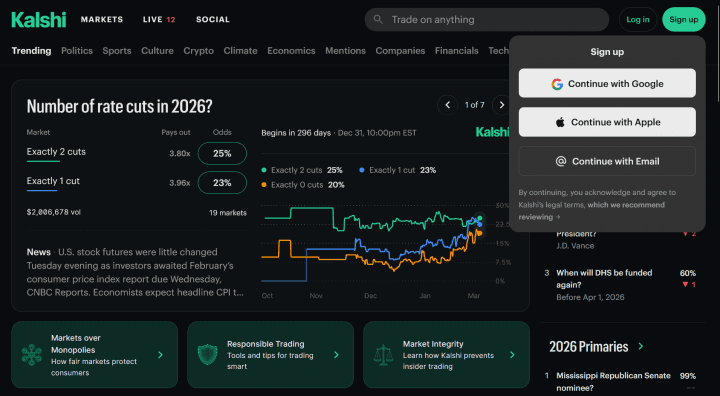
- Register on the platform: Create an account with your email and a strong password.
- Complete the KYC process: The platform will ask for official documents, like a government-issued ID, to confirm your identity and comply with anti-money laundering laws.
- Link your payment method: Connect your bank account through a service like ACH or add a debit card to fund your account.
- Make a deposit: Transfer your starting capital from your linked account. Check the processing times for each method.
- Find and buy your first contract: Look for a market that interests you, check the order book, and place your buy or sell order.
Steps for a Blockchain Platform (like Polymarket.com)
- Set up your wallet: Install a compatible wallet (like MetaMask or Coinbase Wallet) and securely save your recovery phrase.
- Acquire collateral: Buy USDC on a trusted crypto exchange and send it to your wallet address, making sure you use the correct network.
- Connect your wallet to the platform: Go to the official website and choose the option to connect your wallet. Approve the connection in the pop-up.
- Deposit or bridge your funds: If your USDC is on a different blockchain, use the platform’s bridge tool to move it to the network the market uses.
- Find and buy your first contract: Browse the markets, read the settlement rules, and sign transactions with your wallet to make trades.
Common Beginner Mistakes
If you’re new to prediction markets, watch out for these common slip-ups:
- Emotional Trading: Buying a contract because you like a politician or root for a team, rather than evaluating the objective probability, is the fastest way to lose money.
- Ignoring Liquidity: Putting money into a contract with no volume can make it impossible to sell your position if things change.
- Ignoring the Spread: Overlooking the gap between the bid and ask can mean paying a big hidden cost on your trades.
- No Risk Management: Skipping basic risk management is a serious mistake in any form of financial trading.
- Forgetting Opportunity Cost: Tying up a lot of capital in a long-term contract means passing up more immediate opportunities.
- Not Reading the Rules: Failing to understand a contract’s cancellation rules could leave your position void if things get ambiguous.
Basic Risk Management Principles
Risk management is a set of practices traders use to protect their capital over time. Since nobody can predict the future with certainty, these techniques help you structure your trades so that even if a few go sideways, your overall balance holds up.
Start with portfolio diversification and don’t concentrate all your money in one spot. Pair that with strict position sizing, meaning you only commit a small, fixed percentage of your total capital to any single contract. Finally, consider hedging by buying contracts on the opposite outcome to limit your downside if the market gets too volatile.
This article was prepared in collaboration with Predictionist.com, a leading resource for prediction market insights and analysis.
Frequently Asked Questions About Prediction Market Platforms
What is a prediction market?
A prediction market is a platform where you can buy and sell contracts based on the outcomes of future events. The price of these contracts represents the market’s perceived probability of the event occurring.
How do prediction markets work?
Prediction markets use an order book where users trade forecasts. If you buy a contract for the winning outcome, it pays out .00. If the event does not happen as predicted, your contract loses all its value.
Are prediction markets legal?
Legality depends on your location. In the United States, exchanges registered with the CFTC are legal. Other regions may regulate them as a form of betting or prohibit them entirely.
Is Kalshi regulated?
Yes, Kalshi is fully regulated as a Designated Contract Market and Derivatives Clearing Organization by the U.S. Commodity Futures Trading Commission (CFTC).
Is Polymarket legal in the US?
Yes, Polymarket received approval from the U.S. Commodity Futures Trading Commission and now accepts clients from the United States.
Are prediction markets gambling or investing?
The legal classification varies. Regulated platforms operate under financial laws as derivative contracts. Other jurisdictions classify them under sports betting regulations.
How do prediction market platforms make money?
Platforms generate revenue by charging transaction fees, spreads on withdrawals, or commissions based on the contract’s projected profit.
Which platform has the most liquidity?
Polymarket and Kalshi are in close competition for market leadership. Together, they account for the vast majority of total liquidity globally.
Can you lose all your money?
Yes. If you buy a contract and the outcome does not match your prediction, you will lose 100% of the capital invested in that specific position.
What’s the difference between Kalshi and Polymarket?
Kalshi is a regulated U.S.-based exchange that uses dollars and requires KYC. Polymarket is a global platform that operates with cryptocurrencies, requires a self-custody wallet, and does not require manual verification (unless you are a U.S. client).