
How Pricing Works in Prediction Markets
If you have ever pulled up a prediction market platform and watched the numbers bouncing around in real time, you probably felt a bit overwhelmed at first. But once you understand the mechanics behind those shifting prices everything starts to click into place. What you really see is a crowd of people who put money behind what they believe, and those beliefs get translated into prices you can read almost like a probability gauge.
What Prediction Market Pricing Represents
Every contract price on a prediction market basically functions as a real-time poll, except that people are backing their opinion with actual cash. That makes the signal much more stronger than what a random survey would give you. Here is how it all fits together.
How market prices reflect the perceived probability of an outcome
The price you look at represents the combined view of every trader on that particular platform. When a lot of people believe something is going to happen, they start to buy shares that are tied to that outcome. As they do this, the cheaper shares get scooped up first, and then the next round of buyers has to pay more for what remains. That is what drives the price higher.
Contracts get priced between $0.00 and $1.00, so you are able to convert any price straight into a percentage without much effort.
Say there is a market on whether the Republican Party will win the next U.S. presidential election or not.
- If the "Yes" contract is sitting at $0.65, that is the market saying there is roughly a 65% chance of a Republican win.
- The "No" contract would then sit at $0.35, which reflects a 35% probability from the other side.
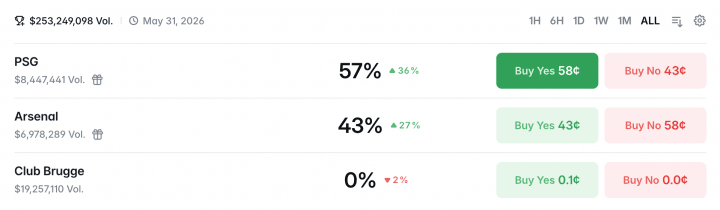
These numbers are not static either. If a positive story breaks for the Republican candidate and then buyers flood in, that "Yes" price could jump up to $0.75. And just like that the perceived probability has shifted to 75%.
Why prediction market prices are easier to interpret than traditional odds
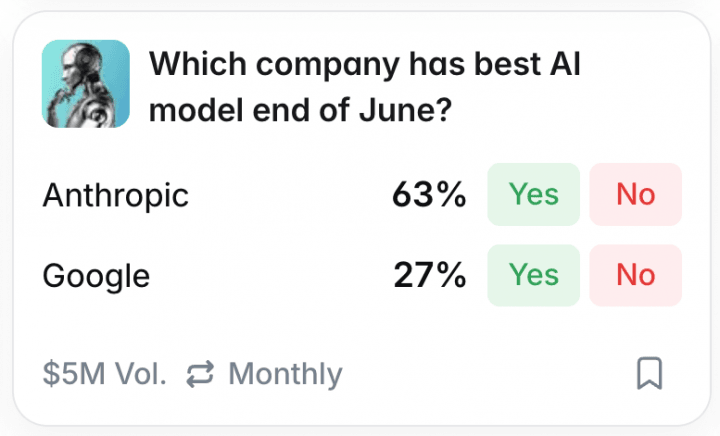
Anyone who has stared at fractional odds like 5/2 or American odds like +250 at a sportsbook knows the mental gymnastics that are involved. Prediction markets skip all of that entirely. A price of $0.40 means a 40% chance. That is it. There is no conversion that is needed.
How Prediction Market Contracts Are Priced
The basic setup is fairly simple. When a market closes the winning contract pays out exactly $1.00, and the losing contract drops to $0.00. While the market is still open, though, the price floats somewhere between those two endpoints, and it is based on what traders do at any given moment.
Why contracts typically trade between $0 and $1
These markets work on a binary system where only two outcomes are possible. The correct one settles at $1.00, which represents 100% certainty, and the wrong one expires at $0.00, which represents 0% certainty. Because the range sits between $0 and $1, any price along the way can double as an easy-to-read probability.
How payout mechanics determine the relationship between price and profit
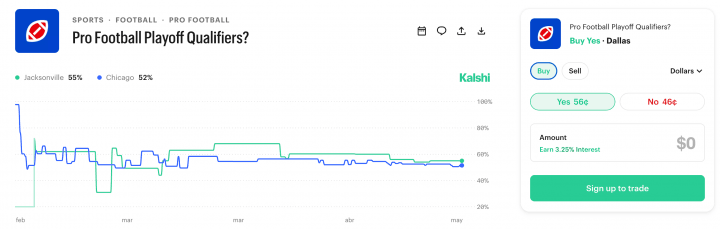
Your profit comes down to the gap between what you paid and the $1.00 settlement price. If you get it right, you pocket that spread. If you get it wrong, the contract drops to zero, but you will never lose more than what you have put in.
Here is an example that uses an NBA market on the Los Angeles Lakers making the playoffs.
- You grab "Yes" contracts at $0.40 each, which reflects a 40% chance at that moment.
- If the Lakers punch their ticket in, each contract settles at $1.00. That is $0.60 per share in net profit. If you buy 100 contracts for $40, you end up walking away with $100, which is a $60 gain.
- If they miss out, though, those contracts become worth nothing, and your loss stops at the $40 that you spent.
How "Yes" and "No" contracts mirror opposite probabilities
"Yes" and "No" contracts will always add up to $1.00 or 100%. If "Yes" is priced at $0.75, then "No" has to be at $0.25. One quick look and you can see exactly how the market splits between the two sides.
How Prices Are Formed in the Market
There is no central authority that is behind prediction market prices. They are built entirely by the people who trade, through a constant back-and-forth of buy and sell orders that shape every price you see on your screen.
How buyers and sellers create prices through supply and demand
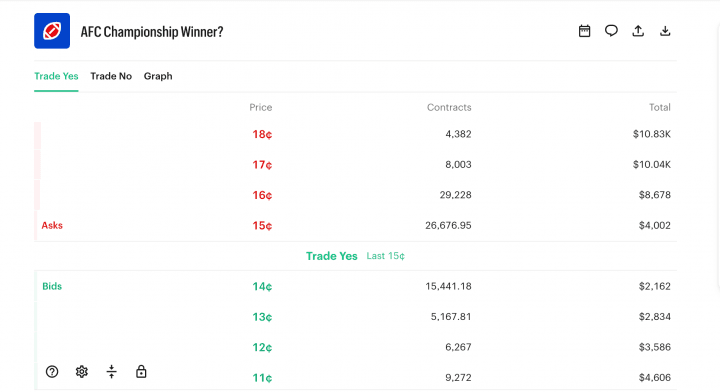
It all comes back to supply and demand, like most things. When buyers rush in for "Yes" shares, the cheapest ones disappear first and then the next available shares cost more. That is what pushes the price up. When sellers outnumber buyers, they have to drop their prices to attract someone who is willing to take the other side, and that pulls the price down.
How bids, asks, and matched orders shape the current market price
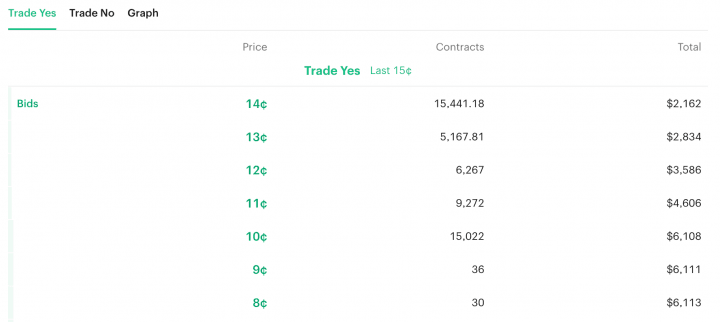
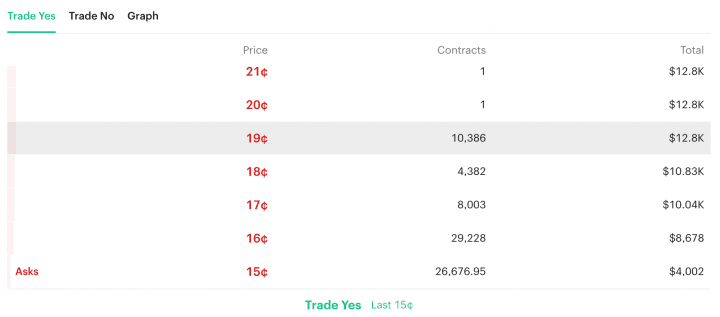
Every trade happens through an order book. Buyers place what are called "bids", which represent the highest price they are willing to pay. Sellers post "ask," which represents the lowest price they will accept. The market price then forms at the exact point where a bid and an ask meet, and a deal actually gets done.
Here is how that looks when you break it down step by step.
- A Bid is Placed: A buyer wants 100 shares at $0.40 each. That order lands in the book, and it sets the current bid at $0.40.
- An Ask is Placed: A seller then lists 50 shares at $0.44. Nobody bites at that price yet, so the order just waits there. The market price stays at the last trade that happened.
- An Order is Matched. A new buyer comes along and agrees to the $0.44 ask and then buys all 50 shares. That trade goes through, and now the market price has jumped to $0.44.
Why each trade can update the market's implied probability
Every completed trade is essentially a fresh agreement between two people on what they think a contract is worth. Since real money is on the line with every transaction, each one of them acts like a vote that adjusts the market's consensus, and it updates the implied probability right on the spot.
What Causes Prediction Market Prices to Move
Price changes are not random. They are driven by real-world events and also by trader behaviour. A headline can shift expectations in just seconds, and a big player who opens a position can move prices just as fast, if not faster.
How breaking news and new information reprice contracts in real time
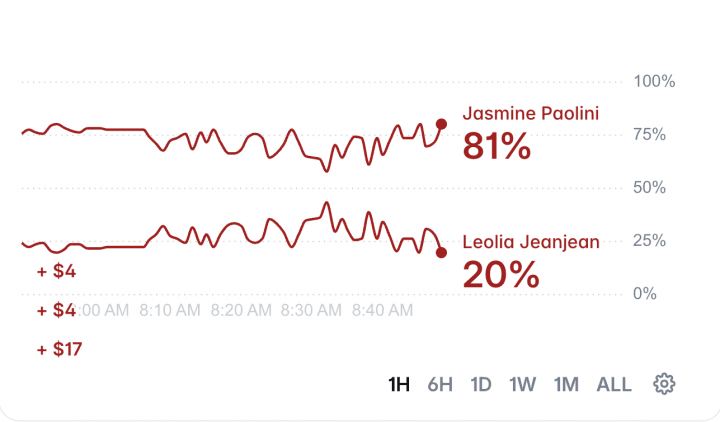
When major news drops, traders do not sit around and wait. They buy or sell immediately so they can adjust, and that can create some very sharp and sudden swings in the price.
A textbook example of this happened during the first presidential debate between Joe Biden and Donald Trump in late June of 2024. As the debate was playing out live, the contract for a Biden victory fell from $0.34 all the way down to $0.22. At the same time, the market on whether he would drop out of the race shot up from $0.22 to $0.43.
How liquidity affects the speed and size of price movements
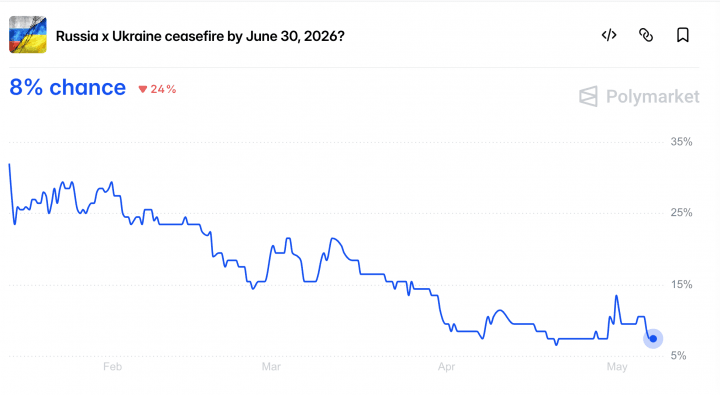
Liquidity, which means the total amount of money that flows through a market, plays a very big role in how stable the prices are.
A market that has high liquidity can absorb large orders without there being wild swings because there are enough traders on both sides to handle it. In a low-liquidity market, though, even a single moderate trade can cause the price to lurch off in one direction pretty quickly.
That is a big reason why platforms like Polymarket and Kalshi sit at the top of the market. They bring together large numbers of users and capital, which lets them handle heavy trading volume without the prices getting distorted too much.
Why low-volume markets can produce sharper and less reliable swings
In a market that is thinly traded, one decent-sized order can gobble up every available share at a given price, and it causes a sudden spike. There simply is not enough capital there to absorb the trade in a smooth way. When that happens, the number on your screen might not reflect what is truly a reliable consensus among traders.
How Traders Interpret Prices in Prediction Markets
Reading the market goes deeper than just checking one number. Traders who have experience will measure what the market implies in probability against their own research, looking for where an edge might exist.
How to read a contract price as a probability estimate
As we covered before, converting a price into a probability takes almost no effort at all. A contract sitting at $0.60 tells you the market sees a 60% chance that the outcome will happen.
Take a market on whether the U.S. unemployment rate is going to rise above 4.0% this month.
- If the "Yes" contract is trading at $0.30, that means traders collectively see a 30% chance it crosses that line.
- The "No" contract would be at $0.70, which points to a 70% chance it does not.
Now imagine a weak jobs report gets released mid-month. That "Yes" price could climb pretty quickly to $0.55, which shows that the market's expectation has now shifted to 55%.
How traders compare market pricing with their own expectations
Traders who are thoughtful about this do not just accept the market price and move on. They do their own work, digging through data, and news and trends so they can build a view of probability that is independent from what the market says.
If your analysis tells you there is a 70% chance of something happening but the contract trades at only $0.40, you may have found a market that is undervaluing that particular outcome.
Why disagreements with the market can create trading opportunities
That gap between what your analysis says and what the market's price reflects, that is where potential for profit lives.
If you believe the market is underpricing an outcome, you are able to buy contracts for less than what you think they are actually worth. On the other hand, if you think the market has gotten too optimistic and the price has been pushed too high, you can take the opposite side and profit in the case that the crowd's overconfidence does not hold up.
How Mispricing Happens in Prediction Markets
The "wisdom of the crowd" does get it right quite often, but it is far from being bulletproof. Human psychology, along with market mechanics, can both cause prices to drift away from what the true probabilities should be.
Why prices do not always perfectly reflect true probabilities
The price shown on your screen is not always an accurate mirror of reality, because the decisions traders make can get skewed. There are a few common reasons for this:
- Cognitive Bias: Traders will sometimes bet on their favourite team or their preferred candidate, and they let personal attachment override what their judgment should be telling them.
- Overreaction: A breaking news story can trigger waves of buying or selling before anyone has really had time to process the full picture of what is happening.
- Limited Information: It is possible that the market does not have access to key data that has not yet been released.
- Market Structure: In a market that is new or has low volume, the earliest price movements might not represent a genuine consensus at all.
How emotional reactions and incomplete information distort pricing
Fear and greed are capable of reshaping a market within minutes. During events that are high-profile, the fear of missing out pushes people into piling onto trades without having a solid reason to do so.
When access to information is uneven, things get worse. If traders act on partial data or headlines that are misleading, the moves the market makes start looking more impulsive than they do thoughtful.
How market inefficiencies can create short-term opportunities
When irrational behaviour pushes prices out of line, windows for profit open up. These mispricings tend not to last very long, though. Sharp traders will spot them and take their positions before the rest of the market catches on and the price starts drifting back toward something more rational.
How Traders Profit from Price Changes Before Resolution
You do not have to sit around and wait for the final result in order to make money. There are plenty of traders who profit just by riding the price swings that happen along the way.
Why traders do not need to wait for the outcome to make money
Just like it works with stocks, you can sell your prediction market contracts whenever you choose to. If you buy in and the price climbs before the event has wrapped up, selling to another trader and locking in your gain right then is perfectly fine. Cashing out early also gives you protection from a last-minute surprise that could send your contract's value all the way down to $0.00.
How buying low and selling high works in prediction markets
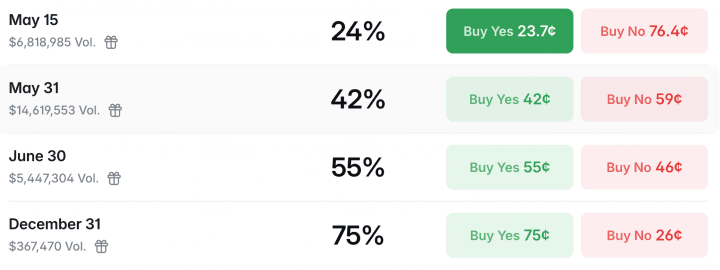
The idea behind this is straightforward. You find contracts the market is undervaluing, buy them when they are cheap, and then sell after the price has moved up to reflect a probability that is higher.
Here is an NFL example that is built around whether the Patriots will qualify for this year's Super Bowl.
| Point in the Season | What Happens | 'Yes' Contract Price | What You Do |
|---|---|---|---|
| Week 5 | The team suffers 3 straight losses | $0.15 | Buy 100 shares ($15) |
| Week 12 | The team wins 5 consecutive games | $0.45 | Hold your position |
| Week 16 | They secure a playoff spot | $0.70 | Sell 100 shares ($70) |
You turned $15 into $70, which gave you a $55 profit, and all of that without needing to wait for the Super Bowl in February.
How entry timing and exit timing affect returns
Picking the right outcome is not enough by itself. How much profit you make depends heavily on when you get in and also when you decide to get out.
If you buy late, after good news has already pushed the price up, your margin is going to shrink. And if you sell too early because nervousness gets to you, there is a good chance you leave money on the table before your prediction has had enough time to fully play out.
Common Mistakes When Reading Prediction Market Prices
It is easy to misread what the market is telling you if you only look at the surface of things. Here are a few traps that are worth knowing about.
Why price should not be confused with certainty
A high price does not mean something is a lock. A contract at $0.95 reflects a 95% market-implied probability, but that 5% chance of failure is very real, and it ends up happening more often than most people would expect. If you treat the market price as a guarantee, you are setting yourself up to be shocked. An upset has the ability to turn your $0.95 contract into $0.00 in just an instant.
Why ignoring liquidity can lead to poor interpretation of market signals
Do not let yourself get fooled by a price spike in a market that has low volume. When there is not much money changing hands, even a single buy order can create what looks like it is strong momentum. You should always check the trading volume that is behind a move. If there are hundreds or thousands of dollars in recent trades that back it up, then it is a signal worth paying attention to. If there is not, it is likely just noise and nothing more.
How overreacting to short-term movement can lead to bad decisions
Reacting on impulse is one of the worst habits a trader can have. A lot of the price swings you see are just temporary overcorrections that will pass. When you act on impulse, it usually means you end up buying high and selling low, which is the exact opposite of what you want to do. It is better to stick with analysis that is driven by data, filter out the noise that does not matter, and make calls with a clear head.
Why Prediction Market Pricing Matters
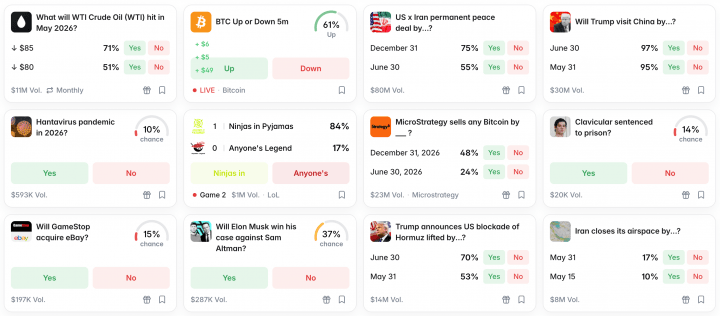
Getting a handle on how the pricing works is something that is necessary for anyone who uses a prediction market. These prices pull together collective knowledge from thousands of participants, and that makes them a powerful signal for when you are forming your own forecasts.
How market pricing aggregates information from many participants
A single market price bundles the knowledge and analysis, and opinions of countless traders into one clean percentage. It captures what they have researched, what their convictions are, and how much financial risk they are willing to take on. You do not just get one person's take on things. You get the full weight of an entire market behind it.
Why understanding pricing improves decision-making for traders and observers
Once you are able to read contract prices accurately, you shift away from guessing based on gut feeling and toward decisions that are grounded in real data. This is useful whether you are trading to make a profit or if you are just keeping an eye on public sentiment and where things might be heading. When you read prices correctly, it gives you a direct window into what the crowd expects to happen next.